
Relocation & Lifestyle · 19 November 2026
Bali's Free Electric Bus: A Practical Guide to the Trans Sarbagita Route from Denpasar to GWK
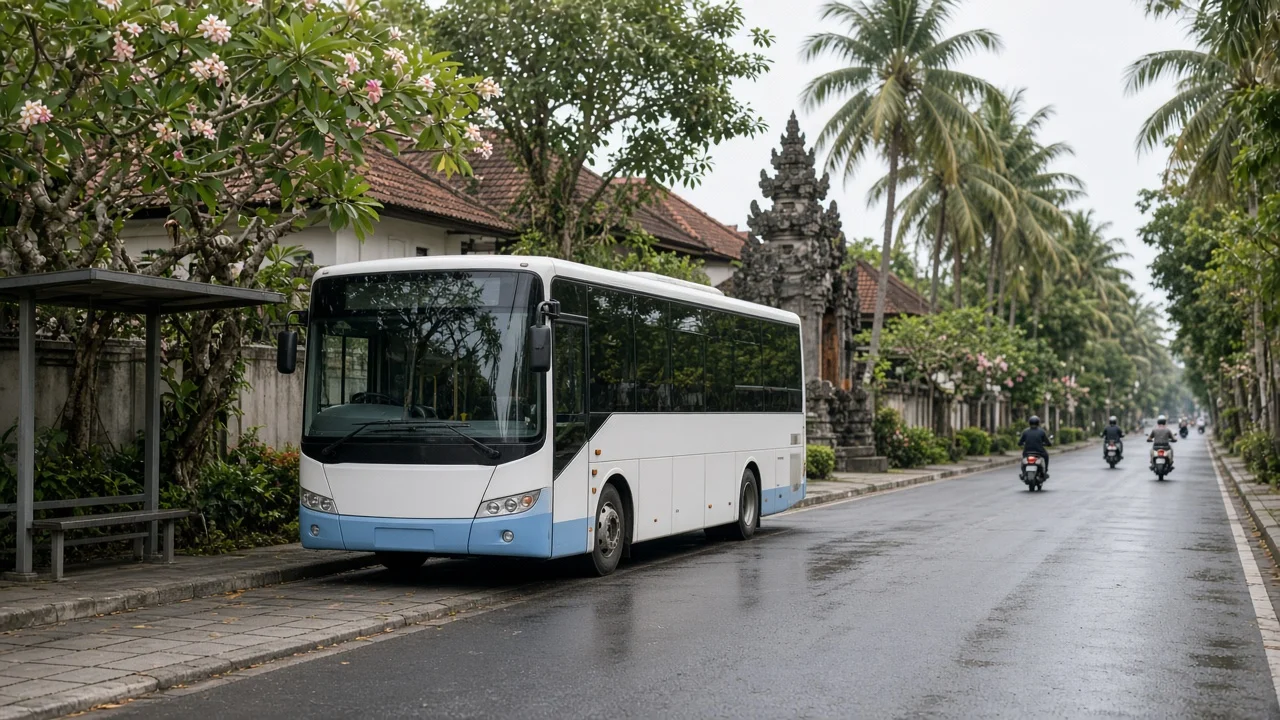
Ask anyone who has lived in south Bali for a while how they get around, and the answer is almost always a scooter, a car with a driver or a ride hailing app. Public transport rarely comes up. Since 9 November 2026, there has been a new option worth knowing about: a fleet of electric buses running free of charge between central Denpasar and Jimbaran on the Trans Sarbagita network.
This guide explains where the route goes, how boarding works, what is still uncertain about the free period, and who is likely to find the service useful, whether you live in Bali, are staying for a few months or are simply trying to spend less time in traffic.
Quick answer
The Bali Provincial Government has started a trial of 11 electric buses on Trans Sarbagita Corridor 1, which runs between GOR Ngurah Rai in Denpasar and Garuda Wisnu Kencana (GWK) in Jimbaran. Rides are free during the trial, but passengers are asked to tap an electronic money card when boarding so that ridership can be counted. If you do not have a card, staff on board can provide one. According to published schedules, buses leave GOR Ngurah Rai from 6:15am, with the last departure at 5:35pm WITA.
Key takeaways
The service is operated by the state transport company Perum DAMRI under the supervision of the Bali Provincial Transportation Office (Dinas Perhubungan, or Dishub).
Ten buses run each day, with one kept in reserve.
The route has 46 stops heading towards GWK and 41 stops on the way back, passing through Renon, Sudirman, Sesetan, Pedungan, Kedonganan, Jimbaran and the Udayana University campus.
Officials have described the free period differently. Check the latest announcement before relying on it beyond December 2026.
In its first eight days, the service carried an average of 415 passengers a day.
Where the electric bus goes
The electric buses follow the existing Trans Sarbagita Corridor 1 for most of the journey, with one notable change. According to the ANTARA news agency, buses leaving GOR Ngurah Rai travel along Jalan Melati and then turn onto Jalan Hayam Wuruk towards the Renon roundabout, before passing through the government district on Jalan Raya Puputan and Jalan Sudirman. From there they join the regular Trans Sarbagita route south.
The head of the provincial transportation office, I Kadek Mudarta, told Tribun Bali that Jalan Hayam Wuruk was added because the area has strong potential demand but had no public transport service at all.
Based on the stop list published by detikBali, the outbound journey towards GWK covers, in broad terms:
North and east Denpasar: GOR Ngurah Rai, Jalan Melati, Jalan Hayam Wuruk and the Renon area, including the Bajra Sandhi monument.
Central Denpasar: Jalan Sudirman and stops near Prima Medika hospital.
Sesetan and Pedungan: a string of stops in Sesetan, then Pesanggaran and Pedungan.
The bypass corridor: Tanah Kilap, Dewa Ruci, Kelan and Kedonganan along Jalan Bypass Ngurah Rai.
Jimbaran and the Bukit: Jimbaran, the Udayana University campus and its hospital, Politeknik Negeri Bali and finally GWK.
The return journey from GWK follows a similar path north, then loops back through Renon via Jalan Cok Agung Tresna, Jalan Moh Yamin, Jalan Raya Puputan and Jalan Hayam Wuruk before finishing near GOR Ngurah Rai.
It is worth being clear about what the route does not do. It does not serve the airport terminal, Kuta, Seminyak, Canggu, Sanur or Ubud. It is a north to south line through Denpasar and down to the Bukit peninsula, so whether it is useful depends very much on where you live and where you need to go.
How boarding works
The provincial transportation office explains the process simply on its official website: go to a stop on Corridor 1 and tap an electronic money card when you board. The tap does not deduct a fare during the free period. It is used to record and count passengers.
If you do not yet have an electronic money card, you can still ride. Mudarta told ANTARA that staff on board will provide a card for passengers to use. For residents who plan to use public transport regularly, carrying your own card is probably simpler, and it is likely to matter once fares are introduced.
Passengers board and alight at designated stops along the route, so it helps to know the name of the stop nearest to you before you set out.
Timetable and frequency
According to the schedule reported by Barometer Bali, there are 20 departures a day from GOR Ngurah Rai towards GWK. The first leaves at 6:15am and the last at 5:35pm WITA. Buses are scheduled to reach the Sudirman area between 6:40am and 6:00pm, and to arrive back at GOR Ngurah Rai between 10:15am and 9:35pm.
Two practical points follow from those figures. First, 20 departures across roughly eleven and a half hours works out to about one bus every 35 minutes on average, so this is not yet a turn up and go service. Second, a full round trip takes around four hours, which means a one way journey from Denpasar to Jimbaran can take well over an hour at busy times.
Mudarta also told Tribun Bali that the electric buses are timed to fill gaps in the regular blue Trans Sarbagita service, typically departing about 15 minutes after a conventional bus. If you are flexible about which bus you take, that can shorten your wait.
Timetables during a trial can change. Treat these times as a guide and allow extra time if you need to be somewhere at a fixed hour, especially during the rainy season, when traffic slows and rain can make waiting at a roadside stop uncomfortable.
How long will it stay free?
This is the question with the least settled answer, and the sources do not fully agree.
The provincial transportation office has described the current phase as a free trial planned to run until the end of December 2026, as reported by ANTARA Bali and ANTARA English.
At the launch on 9 November, Governor Wayan Koster said the service would be free for passengers for one year, with costs covered by the provincial budget, according to Kompas.
Both statements may turn out to be true if the trial is extended without fares, but we have not seen an official announcement that reconciles them. If the free fare matters to your plans, check the transportation office's latest information towards the end of December.
Who might find it useful
The route will not replace a scooter or a driver for most people, but it can make a real difference for some:
Residents in Renon, Sesetan and Pedungan who commute to central Denpasar or south towards Jimbaran.
Students and staff at Udayana University and Politeknik Negeri Bali in Jimbaran.
People attending appointments in the Renon government district, such as visits to provincial offices or the Samsat vehicle registration office, which has a stop on the return route.
Longer stay visitors based in Jimbaran or Kedonganan who want a low cost way into Denpasar, or a relaxed trip to GWK.
Anyone who prefers not to ride a scooter, particularly in heavy rain or at peak traffic times.
For families or people with limited mobility, it may be worth trying a short section of the route first to see how the stops, steps and walking distances suit you.
Why this matters for Bali
Traffic is one of the most common frustrations for residents and visitors alike, and road space in south Bali is limited. At the launch, the governor urged the public to move from private vehicles to public transport for exactly that reason, according to Kompas. The buses were provided through a grant from the South Korean government, in cooperation with Indonesia's national planning ministry Bappenas and the Global Green Growth Institute, as part of a project known as Bali e-Mobility, ANTARA reported.
Early numbers are modest but encouraging. In its first eight days, from 9 to 16 November, the service carried an average of 415 passengers a day, with a low of 325 on Saturday 14 November and a high of 547 on Monday 16 November, according to figures from the transportation office reported by Kompas. Officials have said that the results of the trial will inform how the service develops, so how many people use it now may shape whether more routes follow.
Practical tips before your first ride
Find the stop nearest to you on the published stop list, and note its name.
Carry an electronic money card if you have one, and expect to tap it even though the ride is free.
Allow plenty of time. A long route with many stops is better suited to relaxed journeys than tight connections.
Pack a light raincoat or umbrella during the wet season, as you may be waiting outdoors.
Keep an eye on official announcements from the Bali Provincial Transportation Office for timetable or fare changes.
Frequently asked questions
Is the Trans Sarbagita electric bus really free?
Yes, during the current trial. Passengers tap an electronic money card to be counted, but no fare is charged. Officials have given different indications about how long the free period will last, so check for updates around the end of December 2026.
Can visitors use it, or is it only for residents?
It is a public bus service, and the transportation office has invited the public to try it. None of the official announcements we reviewed mention a residency requirement.
Do I need an electronic money card?
Having one is helpful, but you can still ride without it. Staff on board can provide a card for you to tap.
Does the electric bus go to the airport?
No. The route runs along Jalan Bypass Ngurah Rai near Kelan and Kedonganan, but it does not stop at the airport terminal.
What time is the last bus?
Published schedules show the last departure from GOR Ngurah Rai at 5:35pm WITA. Buses on the return leg continue into the evening, arriving back at GOR Ngurah Rai as late as 9:35pm.
Continue exploring
Bali's 2026/27 rainy season: a practical guide for residents, renters and villa owners
Beyond the Bali Facebook group: finding advice you can trust
Settling into daily life in Bali?
Small practical questions, like how to get across town without a scooter, are often part of a bigger picture: where to live, how to set up your days and whom to ask when something is unclear. If you would like to talk through your circumstances, you are welcome to start a conversation with Touchstone.
By Touchstone Bali. Published 19 November 2026. Routes, timetables and fares may change during the trial; check the Bali Provincial Transportation Office for the latest official information.
References
Sejarah Baru Transportasi Bali, Bus Listrik Trans Sarbagita Mulai Beroperasi, Dinas Perhubungan Provinsi Bali, 9 November 2026.
Bali launches free electric bus service on Trans Sarbagita route, ANTARA News, 8 November 2026.
Gratis, uji coba bus listrik GOR Ngurah Rai GWK mulai 9 November hingga Desember 2026, ANTARA Bali.
Jalan Hayam Wuruk Denpasar Bali Masuk Rute Bus Listrik, Operasional Dimulai Pukul 06.15 WITA, Tribun Bali, 9 November 2026.
46 Titik Henti Bus Listrik Trans Sarbagita Rute Denpasar GWK, Ini Daftarnya, detikBali.
Bus Listrik Trans Sarbagita Gratis Setahun, Berikut Jadwal dan Rutenya, Barometer Bali, 10 November 2026.
Bus Listrik Trans Sarbagita Bali Mulai Diminati, Penumpang Tembus 547 Orang Sehari, Kompas.com, 17 November 2026.